How New California Building Codes Affect Your 2026 Siding Replacement
How New California Building Codes Affect Your 2026 Siding Replacement
Homeowners comparing siding contractors Bay Area this year are running into a new reality. The 2025 California Building Codes took effect January 1, 2026, and San Francisco moved most exterior permits into the PermitSF digital portal on February 13, 2026. Those two changes reshape how siding replacement is specified, permitted, and inspected in San Francisco, the East Bay, Marin, the Peninsula, the South Bay, and Sacramento. The right material, fastener class, and weather barrier sequence now matter as much to code compliance as they do to curb appeal.
This article explains what changed, how those changes impact actual scopes in neighborhoods from the Outer Sunset 94122 to the Oakland Hills 94605 and Folsom 95630, and why material selection in 2026 favors noncombustible cladding with proven moisture control. It also shows the permit pathways and price ranges homeowners will actually see. Property owners comparing siding contractors Bay Area can use this as a clear benchmark while planning a compliant project that protects the building envelope for decades.
What changed on January 1, 2026, and why it matters for siding
The State of California updates its building standards every three years. The 2025 California Building Codes, which took effect on January 1, 2026, drive three practical shifts for siding replacement:
First, Wildland-Urban Interface rules continue to tighten in the East Bay Hills and other mapped fire zones. Chapter 7A of the California Building Code requires noncombustible exterior wall coverings in many hillside addresses in Oakland, Berkeley, Orinda, Lafayette, and Moraga. Fiber cement products with a Class A flame spread rating and noncombustible classification satisfy these rules. Vinyl, cedar, and redwood do not. That is now enforced at permit intake and again at inspection.
Second, water management details are more visible to inspectors than they were a decade ago. Expect scrutiny of the weather resistant barrier sequence behind the siding, flashing at window heads and sills, drip edges, kickout flashing at roof-to-wall turns, and the continuity of the drainage plane. Field-primed cut edges on fiber cement are not optional. They are part of a durable assembly that meets the intent of the code and the manufacturer’s warranty language.
Third, Title 24 energy rules tie into exterior wall work whenever a siding project exposes sheathing or interfaces with window openings. Builders must seal the envelope to the same standard as a window upgrade. That means attention to air sealing around penetrations, correct tape over WRB seams, and caulk selection that survives the local microclimate. For San Francisco’s fog belt and waterfront, that sealing requirement often calls for marine-grade polyurethane caulk to prevent joint failure under salt exposure.
San Francisco’s PermitSF digital portal changed timelines
San Francisco projects that used to bog down at 49 South Van Ness now move online. PermitSF centralizes most siding replacement filings, including in-kind replacements. The city’s stated target for simple in-kind approvals is 48 hours when the submission package is complete and the scope is outside historic review. In practice, correctly assembled in-kind fiber cement applications in residential zip codes like 94122, 94116, 94118, and 94114 have been clearing in as little as two business days. That is a very real time savings over the multi-week waits owners remember from pre-digital filing.
Historic districts and visible street-facing elevations in places such as Alamo Square, Liberty Hill, and Dolores Heights still require Planning review under the Preservation Design Standards that became effective on April 1, 2025. Expect Planning to add three to eight weeks, depending on whether the proposed profile and reveal match the original redwood or Douglas fir. Projects that match historic exposures, such as a 4.5-inch reveal in HardiePlank Cedarmill with HardieShingle accents on a Queen Anne gable, move faster than proposals that alter the façade.
Material choices that meet 2026 code and Bay Area reality
Fiber cement remains the workhorse for Bay Area replacements. James Hardie’s product line meets the durability and code profile required across coastal San Francisco, the East Bay Hills, Marin waterfront, and Sacramento’s heat cycle. HardiePlank lap siding, HardieShingle, and HardiePanel vertical siding comply with ASTM C1186 and C1325 standards, carry a Class A flame spread index per ASTM E84, and are classified as noncombustible under ASTM E136. That meets Chapter 7A’s noncombustible requirement in WUI zones and gives owners a predictable 30-year product warranty. ColorPlus Technology, the factory-applied finish, carries a 15-year fade warranty and saves a field-paint cycle in high-sun microclimates like Noe Valley 94114 and Walnut Creek 94598.
San Francisco and coastal Marin should be specified under the HardieZone 4 coastal system. That set of best practices, when executed correctly, protects against wind-driven rain and salt-laden marine moisture. It includes stainless steel ring-shank fasteners in the fog belt and waterfront zones, correct WRB overlaps, Z-flashing at butt joints, kickout flashing at roof intersections, and field-primed cut edges. In the Sacramento Valley and inland Contra Costa, HardieZone 5 applies, with hot-dip galvanized fasteners usually sufficient and a focus on ColorPlus finishes that resist UV fade.
Vinyl has a place inland, especially insulated vinyl such as Prodigy in Sacramento suburbs like Roseville 95661. Proper expansion and contraction calibration is critical where summer highs hit 105 degrees and nights cool quickly. Vinyl is not allowed in many WUI fire zones and tends to struggle under salt fog. It is the wrong choice for the Outer Sunset 94122, Sea Cliff, Sausalito 94965, or any waterfront-facing façade in the Marina 94123.
Cedar and redwood remain essential for historic homes where Planning requires in-kind restoration. Grade-A western red cedar shingles can satisfy preservation standards in Pacific Heights, Alamo Square, and Lower Pacific Heights. Owners often choose to preserve street façades in cedar and replace side and rear elevations with fiber cement lookalikes that hold paint longer and resist ignition from embers. That hybrid approach balances Planning, long-term maintenance, and total cost.
Engineered wood products, such as LP SmartSide, are common in other markets but face two local hurdles. First, they are combustible, which is a nonstarter in many WUI addresses. Second, they tend to require tighter maintenance cycles under Bay Area moisture conditions than fiber cement. Many property owners who compare these materials with siding contractors Bay Area end up specifying fiber cement on all fire-exposed elevations and saving engineered wood for low-risk inland or accessory structures.
Microclimate drives specification in the Bay Area and Sacramento
No other U.S. Metro region puts a home through the same spread of exposures. From Karl the Fog at Ocean Beach to the dry heat of Elk Grove, the wrong fastener or caulk choice can void a warranty or shorten service life. The brief below matches fastener class, sealant, and system choices with neighborhoods and zip codes many owners share when calling siding contractors Bay Area.
- San Francisco fog belt: Outer Sunset 94122, Parkside 94116, Outer Richmond 94121, Inner Richmond 94118, Sea Cliff. Use HardieZone 4, stainless steel ring-shank nails, and marine-grade polyurethane caulk. Expect wind-driven moisture and salt.
- San Francisco sun belt: Mission 94110, Castro and Noe Valley 94114, Glen Park 94131, Bernal Heights, Potrero Hill 94107. Hot-dip galvanized fasteners work. Focus on ColorPlus fade resistance for south and west exposures.
- San Francisco waterfront and bayside: Marina 94123, North Beach 94133, SoMa Waterfront 94105, Dogpatch 94107. Treat as marine-adjacent. Specify stainless fasteners and marine-grade sealant.
- East Bay marine influence: Oakland 94612, Alameda 94501, Berkeley 94703. Hot-dip galvanized fasteners are generally adequate, with stainless upgrades within a mile of the waterline. Watch for salt-driven fastener head staining on west elevations.
- East Bay WUI fire zone: Oakland Hills 94605 and 94611, Berkeley Hills 94708, Orinda 94563, Lafayette 94549, Moraga 94556. Chapter 7A mandates noncombustible cladding. Fiber cement satisfies; vinyl and cedar do not.
In the Sacramento Valley, heat cycling stresses vinyl and lower-tier sealants. Folsom 95630, Roseville 95678, and Sacramento 95818 typically see hot-dip galvanized fasteners, a HardieZone 5 specification, and a ColorPlus finish in lighter tones on west and south elevations to reduce heat gain. Owners who tried darker field paint over wood often call siding contractors Bay Area after four to six summers of premature fade. Factory finish fiber cement holds color longer.
Removal and replacement scope in 2026
A compliant reside in 2026 is more than a tear-off. Inspectors and warranty reps look for a system. That system starts with a site assessment that checks for dry rot and OSB or plywood sheathing damage, then proceeds through removal, substrate repair, WRB installation, flashing integration, and the siding field install with correct fastener spacing and depth. Over-driven nails that fracture the face of fiber cement void manufacturer coverage and invite moisture through micro-cracks.
Dry rot shows up first as peeling paint or soft trim. In San Francisco and Marin, west-facing walls present the worst damage. In our field documentation, bubbling siding usually means moisture has already reached the sheathing. That turns a straightforward $25,000 reside into a $33,000 to $40,000 scope when OSB replacement and structural shims enter the picture. Typical add-on ranges for sheathing repair run $3,000 to $8,000, depending on the damage spread and access constraints along tight side yards in neighborhoods like the Richmond District 94121 or Bernal Heights 94110.
Moisture control depends on the weather resistant barrier. HardieWrap, Tyvek, or an equivalent WRB should be lapped shingle-style. Window head flashing must sit over the WRB, while the jamb and sill membranes lap correctly to shed water to the exterior face of the barrier. Kickout flashing at roof-to-wall junctions stops roof runoff from driving behind the siding. Z-flashing at butt joints and drip caps above trim redirect water forward of the wall plane. These details take time and show up plainly on inspection day.
Asbestos cement siding on pre-1981 homes
Many Bay Area homes built before 1981 carry transite asbestos cement siding under later layers of wood or vinyl. Removal requires a licensed abatement protocol, EPA Lead-Safe Certified handling for associated paint hazards, and CARB-compliant disposal in sealed bags at an approved facility. Typical removal fees add $7 to $12 per square foot on top of standard replacement pricing. Owners often discover asbestos during tear-off when old layers emerge along utilities or behind garage elevations. A proper bid from siding contractors Bay Area will include a contingency line for hazardous-material handling if the home’s age and profile suggest the risk.
What inspectors look for in a compliant fiber cement install
Inspectors across San Francisco DBI, Oakland Building Bureau, Berkeley’s Permit Service Center, Marin County Community Development, and Sacramento Community Development tend to focus on the same field markers:
They check for a functional drainage plane. That means the WRB sheds water without reverse laps and that flashing layers drain to daylight. They watch nail depth and spacing. Flush-driven fasteners that do not fracture the board are mandatory on fiber cement, usually placed 1 inch down from the top of the lap and at manufacturer-specified centers. They scan butt joints for correct gapping and either joint flashing or sealed H-molds, depending on product and profile. Cut edges must be field-primed before install. Caulk beads should be continuous, sized correctly, and struck to a smooth profile without voids.
Material compliance also matters. James Hardie boards arrive labeled to ASTM C1186 and C1325, with installation per the HardieZone 4 or 5 best practices depending on address. Owners who compare siding contractors Bay Area should ask to see the intended fastener spec by microclimate. Stainless steel ring-shank nails are the right call in the Outer Sunset and Marina. Hot-dip galvanized nails are correct inland. Marine-grade polyurethane caulk is non-negotiable within the salt exposure zone.
San Francisco permitting in practice for 2026
Under PermitSF, most siding replacement projects fall into one of two tracks. Knowing which track a home is on helps owners plan timelines around the rainy season and school calendars.
- In-kind replacement, non-historic: Upload scope, photos, product documentation, and a concise plan noting WRB and flashing details. Approvals can land within two business days for addresses such as 94122, 94116, 94118, and 94114. DBI inspections verify code items on site.
- Historic façade or district: Provide profile and reveal details, product data sheets, and photos that prove visual matching. Planning review adds three to eight weeks. Expect this pathway in Alamo Square, Liberty Hill, Dolores Heights, and portions of Pacific Heights.
Owners still mention the old 49 South Van Ness Avenue routine. The digital switch is a real improvement for simple projects. It has also set a higher bar on submittal clarity. Clean scope notes that reference HardieZone 4, stainless fasteners where applicable, and kickout flashing at roof intersections tend to sail through. Vague scopes stall.
Cost ranges across 2026 Bay Area and Sacramento projects
Installed cost per square foot still spans a wide range because of architecture and access. A single-story ranch in Concord or San Jose can run $7 to $14 per square foot in fiber cement. Two-story homes with scaffolding, courtyard access, or zero lot lines trend higher. San Francisco’s labor market premium and Victorian detail add 25 to 40 percent over similar East Bay or Sacramento scopes. That puts full replacement on many San Francisco Victorians in the $25,000 to $55,000 bracket, with higher numbers when façades carry elaborate bays and cornices.
Owners hear a second number after tear-off. Dry rot and sheathing replacement often add $3,000 to $8,000 when peeling paint and bubbling clapboards hinted at deeper problems. Hazardous-material removal, if needed, adds $7 to $12 per square foot. Most fiber cement projects return 80 to 95 percent of cost at resale in strong neighborhoods, with the highest return seen where noncombustible cladding helps with insurance and WUI compliance in places like Berkeley Hills and Lafayette.
Neighborhood examples that show the 2026 code in action
Outer Sunset 94122, west elevation: A 1958 house shows cupped redwood and failing paint on the Ocean Beach side. The 2026 scope calls for full removal, HardieWrap, stainless steel ring-shank nails, marine-grade polyurethane caulk, and HardiePlank Cedarmill with a 4.5-inch exposure under HardieZone 4. Z-flashing appears at butt joints. Kickout flashing is added where a small shed roof meets the wall. PermitSF approves in-kind within two business days. DBI signs off after checking fastener depth and WRB laps. This wall is the reason marine-grade sealant is the standard here.
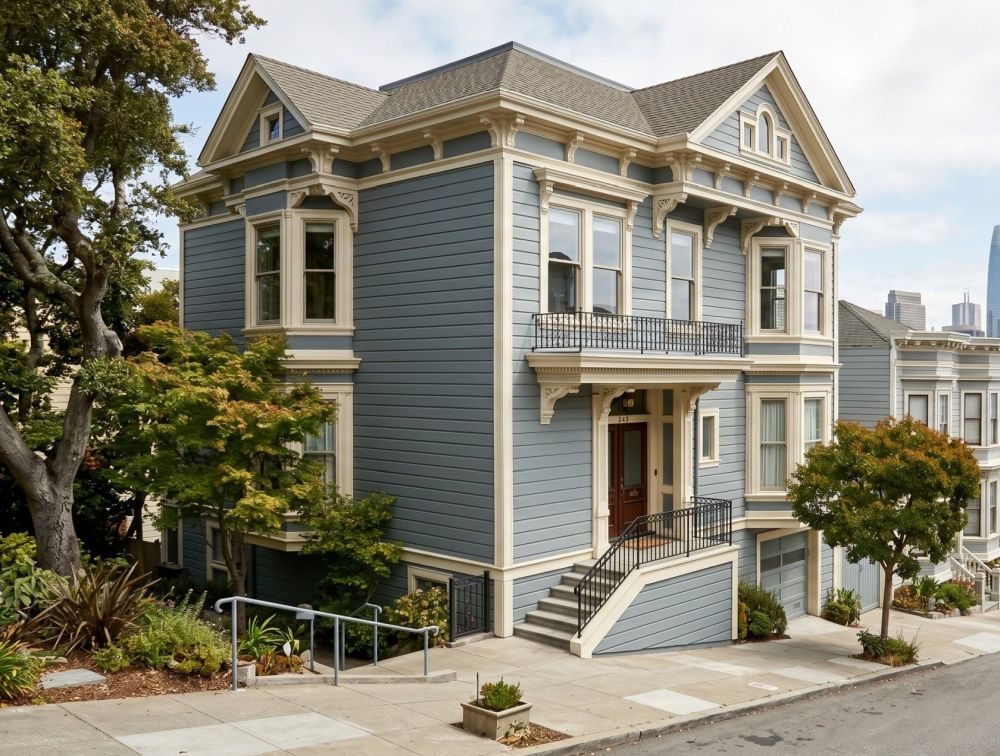
Pacific Heights 94115, Victorian façade: Planning asks for a profile match under the Preservation Design Standards. The owner keeps the street elevation in Grade-A cedar with a matched reveal and uses HardieShingle in the gable to honor the Queen Anne language. Side and rear elevations convert to fiber cement where Planning has more latitude. The combined package protects the envelope while honoring the block’s rhythm near Alta Plaza Park and the views toward the Golden Gate Bridge.
Oakland Hills 94605, WUI zone: The owner is replacing aged shingles in a Chapter 7A jurisdiction with views across Lake Chabot. Fiber cement is required to pass plan check. The assembly includes HardiePlank Smooth, hot-dip galvanized fasteners for the mid-slope lot, and a ColorPlus finish that reduces repaint cycles. Inspectors verify noncombustibility and flashing details at roof lines where ember exposure is most likely.
Sausalito 94965, waterfront slope: Wind, salt, and odd angles dominate the site above the Sausalito Waterfront. Stainless fasteners and marine-grade caulk get specified across all elevations. Exposure at the windward corner calls for extra attention to butt joint flashing and a drainable WRB. Crews stage around a narrow lane. The owner required a quieter color palette, so ColorPlus in a light gray was selected to reduce heat absorption and fade.
Folsom 95630, Sacramento Valley: A two-story home in Empire Ranch sees 100-degree highs and cool evenings. HardieZone 5, hot-dip galvanized fasteners, and lighter ColorPlus tones on the west and south walls reduce thermal stress. Prodigy insulated vinyl appears on the detached rear elevation where sun exposure is lighter and city codes permit. Window trim integrates with a planned Anlin window upgrade that must meet Title 24 U-factor and SHGC targets. The combined scope reduces cooling load in July and August.
Windows, trim, and Title 24 when siding touches openings
Many owners pair siding replacement with a window package. Title 24 comes into play for both. Window U-factors and SHGC values must meet the current table for the home’s climate zone. When trim or flanges are exposed, the installation must integrate head flashing, sill pan membranes, and WRB laps in the correct order. In the Bay Area, Certified Anlin Dealer installations supply QuadraTherm dual pane insulation and Infinit-e Low-E glazing that make the envelope much tighter than the original single-pane units still common in Noe Valley 94114 and Russian Hill 94109. Even when the window scope phases in later, the siding crew should prepare the openings for a proper future tie-in.
Quality markers owners can verify without a ladder
Owners often ask what they can check from the ground. Siding lines should run level with consistent reveals. Butt joints should not cluster. Caulk beads at trim joints should be even, smooth, and continuous. On fiber cement, nail heads should not crater the board face. Trim should drain, not trap, water at the tops of bays and over window heads. These simple field signs correlate with the deeper details inspectors review and align with manufacturer best practices that keep warranties intact.
Scheduling around Bay Area weather and the PermitSF calendar
The fog belt and rainy season shape calendars. Crews prefer to install WRB and siding during dry windows to protect the sheathing. PermitSF’s faster in-kind approvals make it easier to aim at spring and early fall in the Outer Richmond 94121, Outer Sunset 94122, and Sea Cliff when wind and fog are less aggressive. East Bay and Sacramento schedules revolve around heat. Installers avoid peak afternoon work on west elevations in July and August and plan paint touch-ups or ColorPlus touch-up kits for mornings and evenings when surfaces are cooler.
Why contractor selection matters more in 2026
The code and microclimate details above come together in the field. Siding contractors Bay Area who work from Oakland 94612 across to San Francisco 94111 and up to Marin and down to San Mateo are used to swinging between stainless fasteners on the coast, WUI assemblies in the hills, and heat-cycle calibration inland. That muscle memory shows up in fewer call-backs, cleaner inspections, and warranty coverage that actually applies if a board ever needs replacement.
Owners should expect bids that name the HardieZone 4 or 5 path, state stainless or hot-dip galvanized fastener class by address, and reference WRB, Z-flashing, kickout flashing, and field-primed cut edges. They should also see a permit plan that fits the parcel’s history and a timeline that respects Planning windows in historic districts near Alamo Square and Dolores Park. This level of specificity is standard for siding contractors Bay Area who take responsibility for the entire envelope, not just the surface.
A shareable reality about 2026 approvals in San Francisco
One change surprises most owners. With a complete digital submittal that matches existing profile and specifies a HardieZone 4 assembly, in-kind fiber cement replacements in neighborhoods including the Outer Sunset 94122, Parkside 94116, Inner Richmond 94118, and Castro 94114 are clearing PermitSF in as little as two business days. That is a huge improvement over the old line at 49 South Van Ness Avenue. The key is a tight package that spells out stainless fasteners, marine-grade caulk where required, WRB sequence, and flashing details. Vague language triggers questions and stalls the clock.
Where the money goes in a Bay Area reside
Labor dominates on complicated façades. Bay windows, ornamental cornices, and narrow access carry setup time in San Francisco, Berkeley, and Alameda. Material selection matters, but execution matters more. HardiePlank Cedarmill or Smooth with ColorPlus saves paint cycles. The Artisan Collection adds deeper shadow lines and suits Pacific Heights and Presidio Heights streetscapes. AZEK exterior trim holds crisp lines at water tables and along the top of bays. All of it must integrate with head flashing, sill pans, and a drainable WRB to work as a system. Siding contractors Bay Area who price these scopes with photo documentation and line items for sheathing, flashing, and trim make it easier to compare apples to apples.
What a code-compliant project timeline looks like in 2026
Owners ask about the calendar as much as the cost. A typical sequence starts with a site walk and photo documentation. The contractor assembles the PermitSF or municipal package, citing HardieZone 4 or 5, fastener class, WRB type, flashing schedule, and, if applicable, historic profile data. In-kind approvals in San Francisco land fast. Historic reviews land in weeks. East Bay, Marin, Peninsula, South Bay, and Sacramento permits follow their jurisdictional clocks. Mobilization brings scaffold and protection. Tear-off reveals any sheathing repair need. WRB and flashing go in next, followed by siding install, trim integration, caulking, and finish details. Inspections occur at WRB and final. Closeout delivers warranty documents and photo sets. Owners who compare timelines from multiple siding contractors Bay Area should press for this level of clarity.
Why fiber cement wins the Bay Area trade-offs in 2026
Fire. Moisture. Maintenance. Those three words summarize the Bay Area’s siding calculus. Fiber cement’s noncombustible classification and Class A flame spread rating satisfy WUI and insurer concerns in the hills. Its dimensional stability under Karl the Fog and wind-driven rain protects the envelope in the Outer Sunset, Sea Cliff, and Sausalito. Its ColorPlus factory finish reduces repaint cycles in the sun belt and Sacramento. ASTM compliance and named warranties back it up. Owners still choose cedar on historic façades and vinyl on some inland walls, but most full replacements across San Francisco, the East Bay, Marin, and Sacramento in 2026 center on fiber cement for those reasons.
Meeting 2026 code is easier with a complete scope
A complete scope is the best insurance policy against surprise delays. It names the product line such as HardiePlank, HardieShingle, or HardiePanel. It references the HardieZone path. It selects stainless or hot-dip galvanized fasteners by address. It lists WRB brand and flashing details. It confirms field-primed edges and flush-driven fasteners. It calls out caulk chemistry. And it aligns with the permit filing language used by DBI, Oakland, Berkeley, Marin, Walnut Creek, San Mateo County, and Sacramento. Siding contractors Bay Area who build scopes this way reduce inspection friction and keep installs moving.
Choosing a contractor in a permit-first city
San Francisco is a permit-first city. Oakland, Berkeley, and Marin are close behind. Homeowners want contractors who do not just say the right things during a walk-through, but who can assemble a passable digital submittal, coordinate DBI inspection points, and tune the field work to the building archetype. The difference between a smooth inspection and a failed one is often a simple field item such as missing kickout flashing where a roof dumps water into a wall. Contractors with high-volume San Francisco and East Bay experience rarely miss those items. Siding contractors Bay Area who can speak both microclimate and permit language are the ones that preserve schedules.
Ready to replace siding under the 2026 rules
Property owners who want a code-correct, warranty-backed replacement this year should work with siding contractors Bay Area who siding contractors Bay Area specify microclimate-appropriate fasteners and sealants, deliver complete PermitSF or municipal packages, and install to the HardieZone best practices. Best Exteriors operates from 1999 Harrison Street Suite 10219 in Oakland 94612 with a cross-Bay dispatch radius that covers San Francisco County, Alameda County, Contra Costa County, Marin County, fiber cement siding Bay Area San Mateo County, Santa Clara County, and Sacramento County. The team holds James Hardie Elite Preferred Contractor status for fiber cement, which is required for Double Lifetime Warranty coverage that uncertified installers cannot provide. It is Diamond Certified, BBB Accredited A+, NARI member, EPA Lead-Safe Certified for pre-1978 housing, CSLB Licensed and Insured under License #923505, and manages PermitSF digital applications and DBI inspections on every San Francisco project. As Certified Anlin Dealer, it integrates siding and Title 24 window scopes when owners want a unified envelope upgrade. Best Exteriors offers free in-home or virtual consultations, 100 percent financing options, a current $1,000 off promotion, a Double Lifetime Warranty on all siding installations, and a 2026 California Building Code compliance guarantee. Homeowners comparing siding contractors Bay Area can call +1 510-616-3180 to schedule a no-pressure assessment and receive a clear, photo-documented proposal that aligns with the new 2026 rules.
Best Exteriors
Premium Window & Siding Specialists
The Pacific Heights Standard: We utilize Marvin Ultimate Wood Windows with a U-Factor of 0.22, exceeding 2026 Title 24 standards. Our team navigates the San Francisco Planning Department case-by-case review, securing Form 8 permit applications for historic architectural integrity.